- Event Business Intelligence
- Posts
- Gradually, and then Suddenly
Gradually, and then Suddenly
The AI Gap with Event Profs Is Widening at an Accelerating Pace

Howard Givner
February 25, 2026
In Ernest Hemingway’s novel The Sun Also Rises, one of the characters is asked how he went bankrupt. His answer has been an apt quote for so many situations, particularly in business: “Gradually, and then suddenly.” That may sum up the pace at which white collar workers will be devastated by AI. Anthropic CEO Dario Amodei, for example, thinks AI could eliminate up to 50% of entry level white collar jobs within 1-5 years.
This month a pair of think pieces that painted a dire picture of AI disruption went viral, both of which point to the staggering loss of white collar jobs.
In Something Big Is Happening in AI, and Most People Will Be Blindsided, Matt Shumer, CEO and founder of Otherside AI likens our current moment to February 2020 when Covid started to creep into our consciousness but before everyone realized the full scale of disruption coming our way. Specifically, he says that AI has crossed an important threshold where it’s now capable of creating self-improving systems, making intelligent decisions, and exhibiting judgment and taste for the first time.
The 2028 Global Intelligence Crisis, by Citrini Research, reads as a futuristic letter to investors following the 2nd quarter of 2028. They paint a picture of AI productivity driving the markets to an all time high in October, 2026, until people realize that any short term profit gains from eliminating white collar jobs is more than offset by the removal of all those white collar consumers from the economy, resulting in the economy tanking by 2028.
We’re looking at massive change, both good and bad. The impact on events themselves is net positive, for reasons I dive into below. The outlook for event professionals, however, is decidedly more mixed, and does not bode well for huge swaths of the industry who will be, as Shumer says, completely blindsided, sooner rather than later.
In this issue:
Agency C-Suite Growth Summit launches in NYC, May 12
IAEE buys Exhibitor Group / Exhibitor Live
Wizard Studios merges with VOX Productions
5 AI-driven developments and what they mean for event businesses:
Semafor’s $330M valuation, at a 165x multiple)
Naboo raises $70M for AI-automated sourcing, and the implication for venue sourcing commissions
People, Inc. hosts an Upfront to showcase their event portfolio, as media looks to events to replace ad dollars lost from Google search
AI summaries of emails means the death of (shitty) newsletters & unread marketing emails
If this was forwarded to you, click here to subscribe for free:
M&A Updates
IAEE acquires Exhibitor Group, host of the 3,000-person flagship event, Exhibitor Live. On paper this brings together both sides of the trade show ecosystem, the people who own and run the shows (IAEE) and the people who exhibit at them (Exhibitor Group). IAEE also now gets Exhibitor’s valuable CTSM certification. While there are numerous benefits to merging these audiences, generally associations do well by representing only one constituency. Still, this is a coup by IAEE CEO Marsha Flanagan, who’s pulled of the biggest acquisition in the event industry association space after only being in the role for two years. The industry also owes a debt of gratitude to Mark Johnson, owner of STAR group, who saved the company by purchasing it in 2022 when it was struggling from Covid.
Platinum Equity acquires exhibit house behemoth Czarnowski, which had been rumored to be on the market for some time now. Czarnowski CEO Mark Nagle will move into the Chairman role, and President Jim Milanowski steps into the CEO position.
Wizard Studios and VOX Productions have merged. I’ve spent time with the principals of both firms over the past year, advising them on the merger, and can confidently say this is a home run on numerous fronts. Geographically, with Wizard on the east coast and VOX on the west coast, they’re now a legit bi-coastal production company. More importantly, they’ve been collaborating on jobs for years, and in the process have learned that their cultures and goals align. More on this in a future post, but for now, congrats to Wizard’s Matthew Saravay and VOX’s Shawn & Sara Sedlacek.
MC&A (owned by JTB, the travel conglomerate out of Japan, which also acquired Northstar last fall) acquires Imprint Events Group. Congrats to Imprint founder Nicole Marsh on this milestone.
One Rock Capital buys a majority stake in AFR furniture rentals.
Acquisition opportunity: I’m working with a Canadian event agency looking to acquire a mid-sized agency as part of their growth strategy. The ideal candidate is doing $1M-$2M in adjusted EBITDA, and whose services include sourcing, planning, onsite management, creative design and production. Email me to learn more.
Upcoming Events
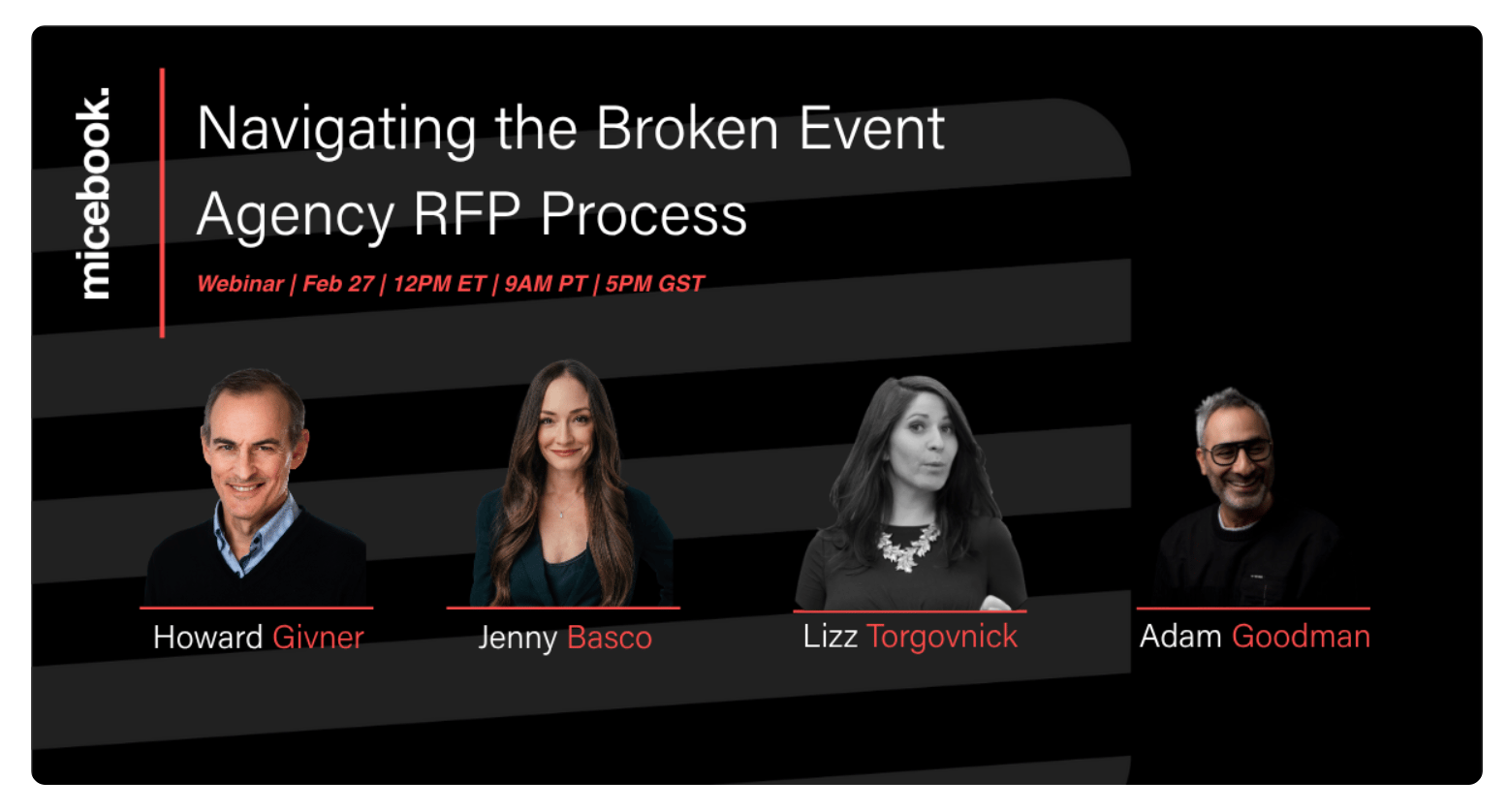
This Friday, February 27th I’m moderating a webinar on Navigating the Broken Event Agency RFP Process, an ongoing challenge facing many - if not most - agencies these days. Join a great panel including :
Adam Goodman, owner and managing director at a*live in London
Lizz Torgovnick, chief creative officer & co-founder at Sequence in NYC
Jenny Basco, chief business officer and partner at NVE Experience Agency in LA.
If anyone’s attending the SISO CEO Summit, March 9-11 at the Kiawah Island Resort in South Carolina, give me a shout so we can meet up. For those who haven’t been, this is a marquis event for owners and operators of trade shows, conferences and other events, both independent ones and large conglomerates (e.g. Informa, Reed, Clarion, etc.) I went last year for the first time and found it to be a great crowd.
On March 30 I’m speaking on M&A at the Executive / CEO Roundtable at Exhibitor Live in Tampa. This will be the first Exhibitor Live show since their sale to IAEE.
NEW: Event Agency C-Suite Growth Summit
On May 12 micebook CEO Chetan Shah and I are hosting a full day Event Agency C-Suite Growth Summit at Neuehouse NYC, following the success of several roundtables and dinners last year. This will be an invitation-only event where owners and leaders of experiential and meeting agencies can share best practices, exchange ideas, discuss common challenges.

Speakers & participants include:
Maureen Ryan Fable | Group CEO at FIRST
Ben Erwin | CEO at Encore
Kim Kopetz | President & CEO at Opus Group
Rob Adams | CEO & Partner at Bishop-McCann
Fiona Bruder | CEO at George P. Johnson
Ori Lahav | CEO at Kenes Group
Trevor Hanks | CEO at Cohera
Ryan Simonetti | President & CEO at Convene Hospitality Group
Andrey Vakhovskiy | Managing Director at H.I.G. Capital
Tim Woodring | Partner & Chief Solutions Officer at Unbridled
Andy Howard | Co-President & Partner at Shamrock Capital
Daniel Curtis | Partner & Chief Strategy Officer at emc3
Janette Roush | Chief AI Officer at Brand USA
Mike Struble | Senior Partner at Eagletree Capital
Melissa Van Dyke | SVP, Technology & Data at Creative Group
Content pillars are M&A, AI/Tech, Talent and Growth. This is shaping up to be a truly special experience.
Gradually and then Suddenly
Conversations about AI’s impact on, well, practically everything in the business world, typically involve a debate on how big the impact will be, and to a lesser extent on how long that will take. Everyone looks at it through the lens of “will it take MY job.”
The problem with such discussions is that the participants are, metaphorically, fighting the last war, meaning they’re focused on what AI can do right now, not in a year, or two or three. For one thing, most people are not using the most advanced versions of AI on the market, but are using older ones with lesser functionality.
Second, and more important, this thinking ignores the blistering, exponential pace of the technology’s development, with capabilities today that are leaps and bounds beyond what existed even six months ago. The average business leader can’t possibly imagine what AI will do in the future.
Consider several recent developments that help explain this impact on events.
1. SaaS-Pocalypse
Earlier this month, a couple of weeks after - and largely because - Anthropic released Claude CoWork, software stocks got hammered in what’s been dubbed the SaaS-pocalypse. Over $300 billion in market cap evaporated, and the earnings multiple for software companies in general fell from 39x in September to 21x, almost a 50% drop.
Translation: investors are more convinced that AI will eliminate the need for much software, and the coders who write it.
Impact on Events: Expect a decrease in the number - and budget - of mega tech events like user conferences and sales kickoffs, and a concomitant hit to the agencies, venues and suppliers who service them.
2. AI Email Summaries Will Kill Many Newsletters & Email Marketing
Warren Buffet famously said “It’s only when the tide goes out that you can see who’s swimming naked.” He was referring to how companies with poor fundamentals can look good in a booming economy, and only have their deficiencies on display when things turn south.
It’s only when the tide goes out that you can see who’s swimming naked.
The same can be said of email newsletters and other content that brands push out to consumers. As Jacob Donnelly of A Media Operator wrote “We’re not in a newsletter bubble; we’re in a shitty newsletter bubble.” We’re about to find out which ones are swimming naked.
If you’re one of the 3 billion people worldwide who use Gmail, you likely started seeing AI Summaries at the top now, enabling recipients to skip reading the whole email. That sounds great, unless you’re one of the many companies that monetizes email newsletters with ads, in which case it’s a big problem. Same goes for a broad range of marketing emails promoting events.
Email used to be the holy grail for reaching an audience, a direct pipeline into your customer’s in box that wasn’t subject to the algorithms of Google, Meta and other platforms. Not so much anymore. AI will not only enable you to quickly preview the contents of emails, it can also learn your preferences and tell you which newsletters to unsubscribe from.
Aggregator newsletters, those that collect and repurpose external articles, are in particular trouble. You can now build your own such aggregator with Ai in under an hour, and it’ll be far better because it’ll be customized for you. The more feedback you give it, the more accurate and useful it’ll be.
To be read, emails need to be useful, by providing insights and context. It’s not enough to share news, you need to explain why that news matters to the reader and what they should do about it. Either that, or they need to have some personality and be enjoyable to read, which is best solved by having an actual person with some style writing them.
Translation: Email open rates will start to plummet, particularly for newsletters of dubious value.
Impact on Events: 1. Associations, publishers, media brands and other organizations that rely on advertising in email newsletters will see major declines in revenue. 2. Events that use email for marketing will struggle if they don’t focus on creating email marketing that people really want to read. 3. With email revenue down, in-person events will further increase in importance as one of the few vehicles for reliable audience engagement.
3. Semafor’s Insane $330 Million Valuation
In January, Semafor, an event company masquerading as a media brand, raised $30 million at a valuation of $330 million, which was based on profits of, wait for it, a mere $2 million. That implies a staggering multiple of 165x, a level normally reserved for AI or other tech companies. Then again, Politico supposedly had similar profit levels in 2018, and Axel Springer bought them for a cool $1 billion in 2021, so maybe the valuation makes more sense than we think.
Semafor belongs to a newer class of digital-first media companies launched over the past decade, including Axios, Puck, and Punchbowl News. Where Semafor differs is their laser-focus on events as the dominant revenue driver. Half their revenue comes from events, the largest of which, World Economy Summit, more than doubled attendance from 2,000 in 2024 to 5,000 in 2025.
We’re not in a newsletter bubble. We’re in a shitty newsletter bubble.
Another leg in Semafor’s strategy is their narrow-but-deep approach to audience curation for their events. The World Economy Summit, which reportedly generates over $10 million in revenue, boasted over 200 major company CEOs last year, a number it expects to double in 2026.
CEO Justin Smith shared the thinking behind Semafor’s events-first business strategy on a recent episode of The Rebooting podcast, where he said, “We are just not in the business of delivering large numbers of eyeballs that may or may not be relevant.” Elite quality beats mass quantity.
Translation: This valuation will spur investment in more events-focused media and journalism companies, and in turn spur legacy media brands to double down on events as vehicles for audience engagement and brand loyalty.
Impact on Events: Coupled with Gmail’s AI Summaries (see above), this reinforces the notion that face-to-face events continue to be reliable opportunities for differentiation and revenue growth.
4. Events As Algorithm-Proof Revenue
Legacy media brands are doubling down on events also, because search traffic to their sites is getting clobbered by AI summaries and constant changes to search algorithm. For example, as I wrote in an earlier post, Condé Nast saw digital traffic to Vogue down 5% in September from the prior year, while Vanity Fair and Glamour fell 40%. In contrast, Vogue World, an experiential event in New York, London and Paris, generated $30 million, a whopping 50% increase from last year.
Similarly, after experiencing a 50% drop in Google Search referrals over the past 2 years, People, Inc. (formerly Dotdash Meredith) is leaning heavily on events to replace lost revenue. So much so, in fact, that on February 11th they held a dedicated showcase for marketers and advertisers just to preview their event portfolio. An ‘Upfront for Events’; who would’ve thought?
Translation: Look for other large media brands to start hosting Upfront-style showcases like this for their event portfolios, which could fuel an arms race of sorts, as companies shift more of their marketing dollars into events.
Impact on Events: Activations at other company’s events will increase significantly, as brands seek algorithm-proof ways of getting in front of their ideal customer profiles.
5. Naboo Raises $70M for AI-First Sourcing
French startup Naboo (yeah, it’s a planet in the Star Wars universe) recently raised $70 million to grow what they call an “AI-powered events procurement platform.” The company reports $119 million in revenue last year and is aiming to hit $1 billion by 2027. And they’re coming to NYC, London and Montreal next.
Since the biggest event expense is typically the hotel/venue, venue sourcing is likely the area Naboo will use as an entry point into companies, like they’ve done so far with Google, Meta, Microsoft and Siemens. Sourcing is viewed as a detail-oriented, time-consuming process that’s more of an administrative task than a strategic one, and should be an easy target for automation, though in fairness many companies have promised such automation in the past, but been unable to deliver it at scale. The difference here could be Naboo being AI-native from the outset.
Solutions like Naboo may ultimately be the final nail in the sourcing-commission coffin that hotels have been grousing about for years. Marriott would surely prefer having it’s AI talk to a client’s AI to fill sleeping room blocks, rather than paying commissions to an army of site selection people.
Translation: AI functionality will enable more parts of the event / meeting planning process to be automated, and numerous startups like this will raise ample funds to ‘build a better mousetrap’ without constraints of legacy players.
Impact on Events: For event planners, AI-driven automation like this will be a huge time saver. *However, it will put a ton of sourcing folks out of work, or at the very least it will make it exceedingly harder for them to justify their commissions or fees.
Conclusion
Noah Cheyer hit the nail on the head with the title of his latest article in his blog, Doing More with Less Using AI: The AI Divide in Events Is Getting Worse, Not Better. The divide he speaks of is between those heavily leveraging AI and those who either aren’t using it at all or are using it sporadically. The productivity gap between those two groups is widening, and with it the value perception gap.
The pace of that gap widening has thus far been gradual, but will soon appear to be sudden, much like the way Hemingway’s character went bankrupt.
Here’s to taking your event business to the next level!
Howard Givner
Senior Advisor | Oaklins: DeSilva & Phillips (M&A)
CEO | Heathcote Advisory Group (Consulting)
Catch up on recent articles:
If and when you’re ready, here are ways I work with event business owners and executives:
Business Coaching & Owner Accountability
Business Diagnostic & Company Valuation
Growth Consulting
Exit Planning
M&A (Buy Side & Sell Side)
Wanna chat? Email me, or schedule an intro call.
If you were forwarded this email and would like to get new weekly articles, click her to subscribe for free: