- Event Business Intelligence
- Posts
- The Call Is Coming from Inside the House
The Call Is Coming from Inside the House
The Unstoppable Force (Trump Chaos) meets the Immovable Object (Events Industry Momentum)

Howard Givner
January 23, 2026
Every January the Eurasia Group, a leading political risk advisory firm, publishes a list of the top 10 global risks for the coming year. The consulting firm, led by Ian Bremmer, advises corporations, NGOs and other organizations on what to look out for in various parts of the world. If you’re a Fortune 500 CEO thinking about expanding your operation in, say, Brazil, and you want to know how stable the country is, this is who you hire.
In the past, the risks identified were usually around countries or trends outside the U.S. This year, however, the call is coming from inside the house. The Eurasia Group’s Top Risks of 2026 is out, and we’ve got three of the top ten, including # 1: “U.S. Political Revolution.” [The others are #3: the “Donroe Doctrine”, and # 6: “State Capitalism with American Characteristics.”] We’re now at what JP Morgan Chase CEO Jamie Dimon calls “the most unstable time since World War II.” Way to go, America. Against this backdrop the events industry is roaring ahead, but can the momentum last?
Below I break down what this means for event businesses, why many industry leaders seem asleep at the wheel in response, and why 2026 could be like riding a roller coaster, blindfolded.
In this issue:
Jack Morton merges with Impact XM
Convene takes over Neuehouse
Feb 27 webinar on the Broken Event Agency RFP Process
The rise of continuation funds
The impact of political risk on events
The World Cup & America 250
Industry leadership’s missing voice
If this was forwarded to you, click here to subscribe for free:
M&A Updates
Last issue I wrote about the Slew of M&A Deals to End the Year, with 15 closings in December alone, including a surprisingly large number of agencies. That momentum shows no signs of slowing, with the announcement this week that Jack Morton merged with Impact XM, in one of the biggest agency deals ever. Impact CEO Jared Pollacco will lead the combined entity, despite Impact being much smaller. One reason could be Impact’s strength in AI, tech and analytics. More to come.
In more agency M&A news, Strata acquired Wonderland. Both are U.K. agencies, though Strata is significantly larger (150-200 FTEs) than Wonderland (around 20-30p). Likely benefits for Strata include gaining Wonderland’s creative expertise, plus the opportunity to grow Wonderland’s marquis brands into larger clients.
Nineteen Group acquired three event businesses to add to its U.S. portfolio, including The Lead, which curates executive forums, an area I see having significant growth in coming years. Nineteen is owned by private equity firm Phoenix Equity Partners.
Convene finalized its acquisition of NeueHouse, the cool co-working and event townhouse in NYC for creative pros, designed by David Rockwell. This is part of Convene’s expansion plans beyond meeting venues and into more production-focused spaces.
Acquisition opportunity: I’m working with a Canadian event agency looking to acquire a mid-sized agency as part of their growth strategy. The ideal candidate is doing $1M-$2M in adjusted EBITDA, and whose services include sourcing, planning, onsite management, creative design and production. Email me to learn more.
I’m seeing an uptick in PE firms putting the event businesses in their portfolios into continuation funds, which, depending on who you ask, is either because they tried to sell the company but couldn’t get a good price, or are nearing the end of a fund’s lifecycle and feel that the business needs a few more years before they can realize quality returns. Nineteen Group (above) was moved into a continuation fund in 2024, and Blackstone is likely to put Clarion into a continuation fund after unsuccessfully exploring a sale last year. On the flip side, InVision Capital got a good exit for Fern after putting it in a continuation fund, enabling it to ride out the Covid years until the market turned around.
Upcoming Events
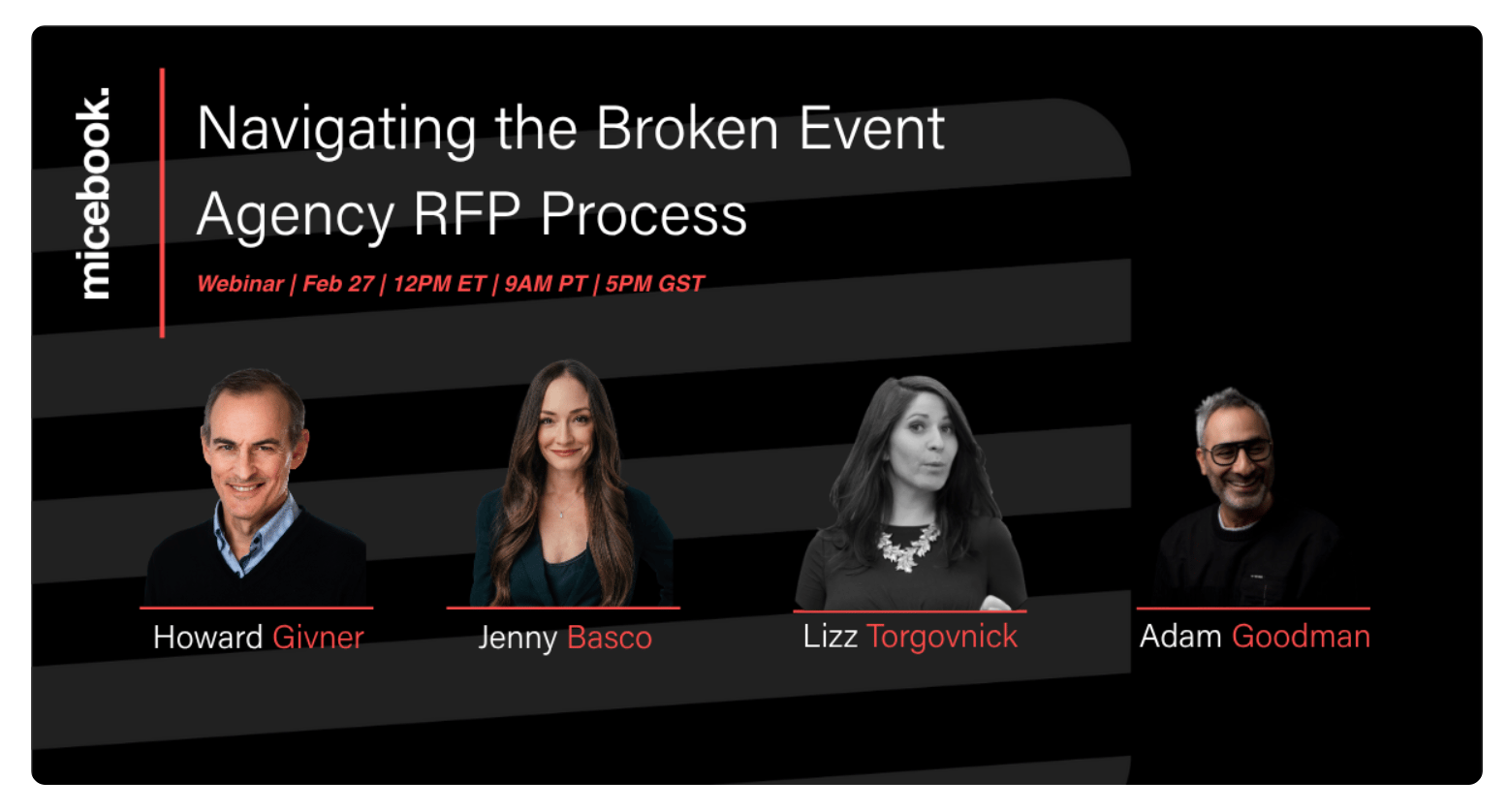
I’m moderating a webinar on Friday, February 27th on Navigating the Broken Event Agency RFP Process, an ongoing challenge facing many - if not most - agencies these days. Join a great panel including :
Adam Goodman, owner and managing director at a*live in London
Lizz Torgovnick, chief creative officer & co-founder at Sequence in NYC
Jenny Basco, chief business officer and partner at NVE Experience Agency in LA.
I’m running a Business Bootcamp at Northstar Meetings Group’s IPEC (Independent Planner Education Conference), Feb 4-6, at the Gila River Resorts & Casino - Wild Horse Pass, in Chandler, AZ. It’s free to attend for qualified hosted buyers.
On May 12 micebook CEO Chetan Shah and I are hosting a full day Event Agency C-Suite Summit at Neuehouse NYC, following the success of several roundtables and dinners last year. This will be an invitation-only event where owners and leaders of experiential and meeting agencies can share best practices, exchange ideas, discuss common challenges. To be notified when registration opens, click here.
The Call Is Coming From Inside the House
As I write this, Donald Trump is waging a campaign to take Greenland from Denmark, a NATO ally, by force if necessary, because Norway didn’t give him the Nobel Peace Prize. Never mind that Norway is not Denmark, or that the Norwegian government has no involvement in the prize. And never mind that the actual winner of the peace prize, Venezuelan opposition leader Maria Corina Machado, gave it to Trump, nor that he had no problem accepting it, which has prompted some of the funniest memes you’re ever going to see.
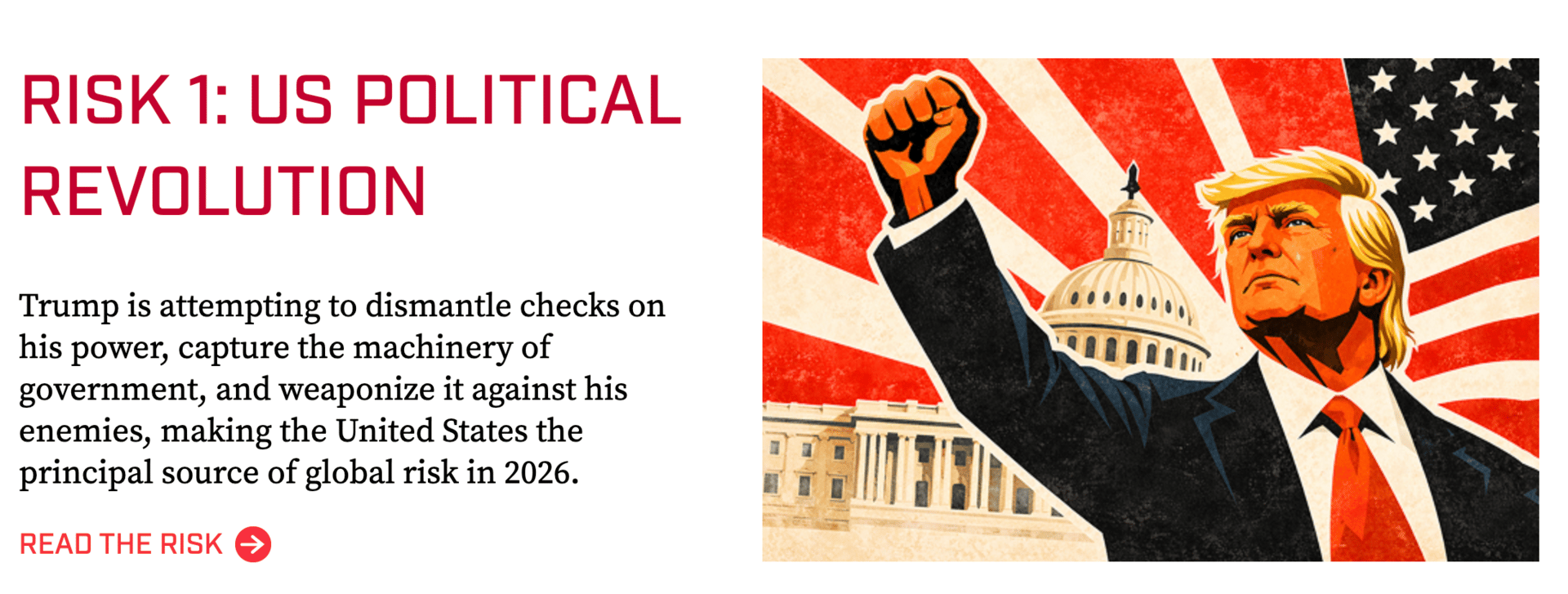
Source: Eurasia Group’s Top 2026 Global Risks Report
After being the recipient of utterly pointless trolling from Trump about being the 51st state, Canada, perhaps the most stalwart US ally, has been driven into the arms of China, and announced a huge new trade deal last week. Canadian PM Mark Carney’s speech at Davos is being hailed as a rallying cry to the rest of America’s allies that the United States is now viewed as a hostile actor, led by a petulant child, which the bulk of this country is seen as supporting.
On the domestic front, we have two armed factions (ICE and the Minnesota National Guard) facing off in Minneapolis, the latest blue American city that Trump, or his vampire advisor Stephen Miller, has sent forces into, following LA, Washington and Chicago. As bad as this is, it’s viewed by many as a test run for the 2026 midterm elections: send ICE into select cities using aggressive tactics to provoke a response, then use that response to trigger the Insurrection Act and shut down voting places, or at least make the environment so volatile that people stay home.
Taken together, these foreign and domestic disruptions helped land the U.S. at the #1 spot in Eurasia Group’s list of Top Risks 2026.
Further, the U.S. State Department may now require inbound travelers, whether they need a visa or not, to submit five years of social media history upon entry to the country. Under the new plan, ESTA applicants would also be required to submit social media usernames, email addresses and phone numbers used over the last five years, plus the names and birthdays of immediate family members. I’ve had half a dozen conversations with event profs who’ve already experienced similar hassles at the border over the past year. As AMI’s James Lancaster rightly points out, this will for sure give many associations pause before hosting their annual meetings in the U.S.
The Impact On Events
I continue to be amazed at the seeming resilience of the U.S. economy in the face of virtually non-stop, self-provoked crises. The unprecedented spending on AI - and the concomitant productivity gains that come with it - are likely drivers of that resilience.
But it doesn’t feel sustainable. It’s like the country is one giant Jenga tower, and Trump keeps pulling blocks out of the bottom and putting them on the top. At some point the foundation collapses. We haven’t seen that happen yet, but I worry that the effects of all this wackadoo shit will kick in in the same way Hemingway wrote about going bankrupt: gradually, and then suddenly.
The U.S. event industry remains incredibly strong, powered by numerous structural tailwinds driving the need for face-to-face interaction, but we’re already seeing an impact. The 2025 Incentive Travel Index, based on a survey of 2,700 incentive travel professionals from 85 countries, released last October by the Incentive Research Foundation and SITE, provided some sobering statistics:
49% of respondents said political considerations are first and foremost in their plans for 2026 and 2027.
70% believe recent political events will result in a decline in inbound incentive travel.
65% think the complex visa process and travel restrictions make the U.S. a less attractive destination.
On the trade show side, a recent Exhibitor Magazine survey showed the impact of ongoing tariff volatility on costs, including the following stats and quotes:
53% anticipate continued cost increases in 2026 due to tariffs
74% of producers are passing some or all of the costs to clients
“Costs on exhibit systems that are assembled in Europe have gone up significantly, which affects most of our domestic vendor partners as well.”
“Customers are not used to dynamic pricing. Quotes that have been valid for months now are now only valid for days.”
Numerous other surveys support these trends. An Ipsos poll last June showed that 62% of Canadian respondents are less likely to travel to the U.S, than last year, almost all of which is due to anger at the Trump administration and increased hassles at the border. Skift Meetings reports numerous events typically held in the U.S. are moving to Canada.
Since most large events are planned years in advance, we’re still not seeing the full effect yet on all the conventions, conferences and meetings that would have come to the U.S. but are now going elsewhere. DMOs work so hard to bring events to their destinations. They’re prepared to compete against each other, but they shouldn’t have to deal with a federal government making things more difficult.
And this is all from just one year of Trump 2.0. Each subsequent year of ongoing chaos and trolling allies will dig a deeper and deeper hole for the U.S. events and hospitality industries to climb out of.
Industry Leadership’s Missing Voice
With the current administration throwing these headwinds at us, it would be nice to think that industry associations would take up the mantle of helping event professionals and businesses navigate such challenging times. But that is wishful thinking.
Anna Abdelnour, founder of Trace, a platform that measures your event’s carbon footprint, wrote a great article on this subject for AMI (Association Meetings International): It’s A Mad World. Associations Shouldn’t Pretend It Isn’t. I’m posting excepts below but I encourage you to read it, as it does a good job of conveying the landscape right now.
An opening panel at PCMA Convening Leaders was supposed to be about navigating 2026 and beyond, and - unsurprisingly - the dialogue very quickly turned to geopolitics, the economy and the ramifications for events and travel. The core message from US Travel Association was - and I paraphrase - “There's a lot going on, some stuff is bad, other stuff is okay… just keep your head down, stay focused on what you can control, and get on with it.”
But the framing, the message, the position: it landed so badly for the room, and in dozens of conversations I’ve had since, it is clear that the majority of the audience felt disappointed.
An association’s role isn’t just to promote the sector or manage reputation. It's to help members make sense of what's happening. To say: here's what we're seeing, here's what we're hearing, here's what's shifting, here's what we're worried about, here's where we think there might be agency.
She’s right, of course, but the recent history of event industry associations points otherwise, the peak of which was their general late and poor response to Covid, not nearly enough of which was geared to helping members survive. Today many associations have become de facto event businesses, with a membership base on the side. Kai Hattendorf’s recent study shows the percent of each association’s budget that comes from membership dues, and PCMA’s is the lowest at 12%.
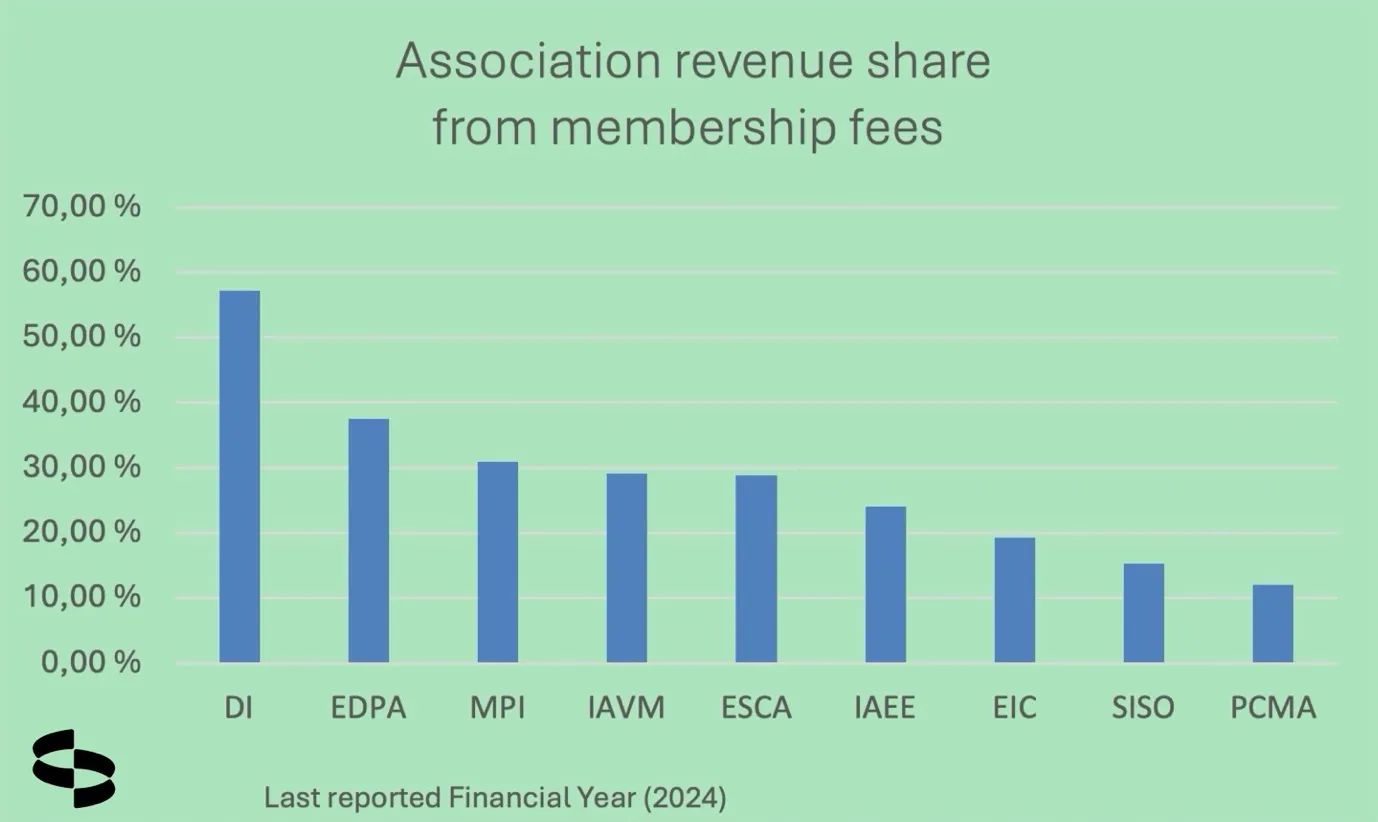
Source: Former UFI CEO Kai Hattendorf
When 88% of your revenue comes from events and other non-member products, your primary focus is going to be on keeping event sponsors happy, not necessarily empowering members to succeed. If associations don’t provide the leadership and guidance the industry needs to succeed in uncertain times, other people and organizations will step in to fill the vacuum.
The World Cup + America’s 250th Anniversary
From June 11 to July 19, the U.S., Canada and Mexico are hosting the World Cup, which will put America under a global microscope for at least a month. Hopefully this will be the shining example we need to show the world that the U.S. remains an incredible place to host marquis events.
Also during that window, on July 4th the United States will mark its 250th birthday as a republic, with a slew of celebrations. It’s a pretty safe bet that Trump will have his presence plastered across many of them, which I fear may invite more potential unrest, and detract from what should be a proud milestone.
This upsets me because I’m a very patriotic person. When I owned my house I flew an American flag, and every July 4th I host a barbeque and pass out copies of the Declaration of Independence, which we all take turns reading aloud. (Try it. You’ll get goosebumps.) I hope we can come together as a country on this occasion, but recent events make me doubtful.
Conclusion
Since Covid, the event industry has gotten much better at navigating uncertainty. The past year feels different. Trump is a master at controlling the news cycle, and has taken his previous efforts to ‘flood the zone’ to new levels. With midterms coming in November, he’s likely to up the ante, and with far fewer guardrails than in his first term, it’s anyone’s guess what new curveballs he’ll send our way.
The events industry has proven remarkably resilient, not only weathering previous disruptions but coming out stronger. People and organizations need to connect on a visceral level; we are social creatures by nature. Long term, I, along with huge swaths of investors, are very bullish on events. But we do ourselves no service by pretending all is well on the homefront here in the U.S.
Here’s to taking your event business to the next level!
Howard Givner
Senior Advisor | Oaklins: DeSilva & Phillips (M&A)
CEO | Heathcote Advisory Group (Consulting)
Catch up on recent articles:
If and when you’re ready, here are ways I work with event business owners:
Business Coaching & Owner Accountability
Business Diagnostic & Company Valuation
Growth Consulting
Exit Planning
M&A (Buy Side & Sell Side)
Wanna chat? Email me, or schedule an intro call.
If you were forwarded this email and would like to get new weekly articles, click her to subscribe for free: